
Gamification
09/12/14
With the return of Game Dev Club meetings, a game night tonight, and hopefully the return of me working on game stuff, I've been thinking about games quite a bit. With my use of Duolingo, I've also been thinking about gamification.
I think gamification is the future in a lot of ways. Well, really, it's now and always has been. Life is but a game, layered with complicated and tedious mechanics, ambiguous goals, and poorly developed pathways to success.
Good and deliberate gamification is the future. Duolingo definitely has the right idea going (though, it has its critics, and probably has a ways to go before its really, really good): take existing problems where solutions can be sold, and set them up in such a way that teaching people how to solve those kinds problems actually creates sellable solutions.
In the case of Duolingo, it sells collaborative user translations of learning language content into their native language (for example, at some point I'll translate Spanish and/or German into English). The site itself presents the learning in a simple game format, and provides a good challenge curve of more and more language content and concepts to tackle. So far, I have neither had the experience of doing busy work nor of having a challenge I was in no way prepared for. I feel the curve is pretty similiar to the one given in Art of Game Design.
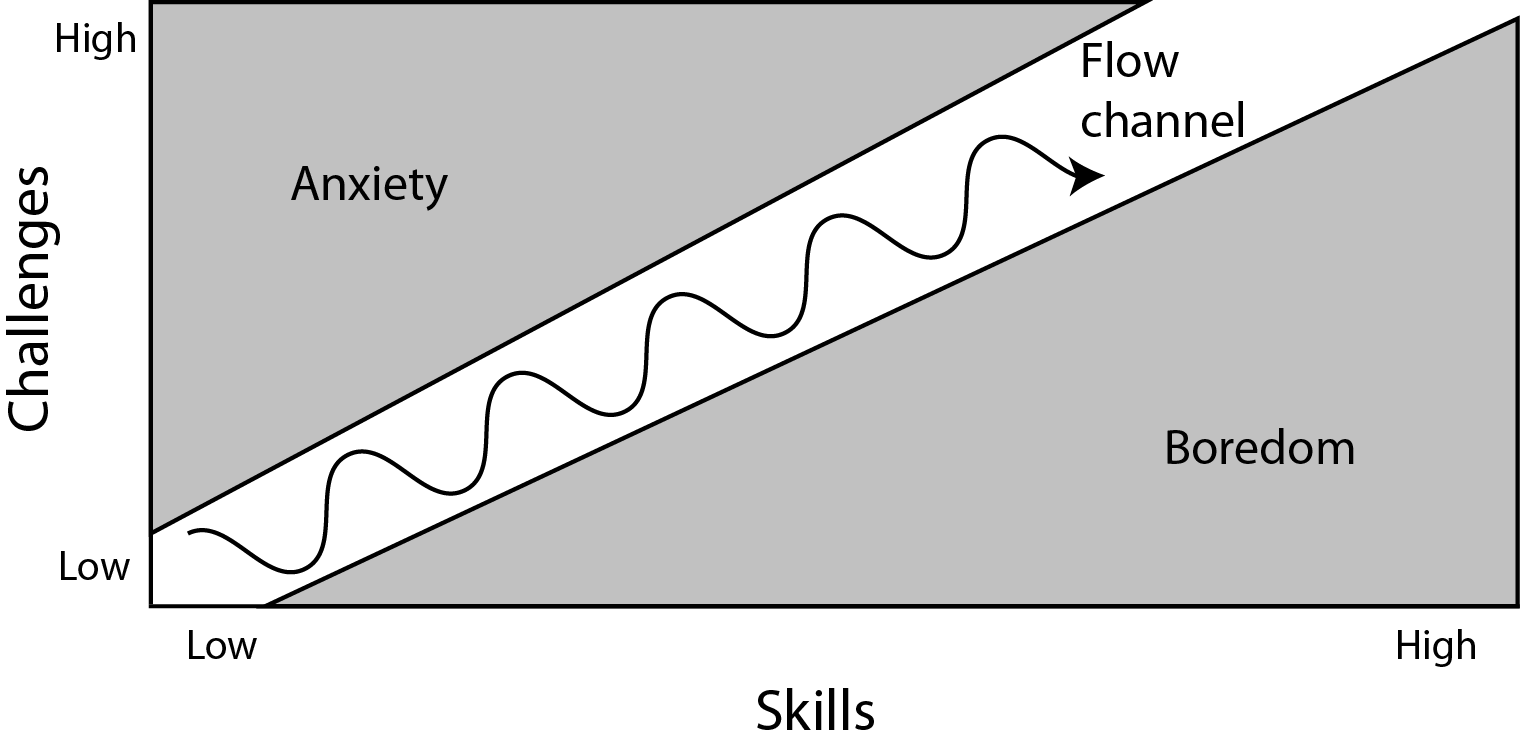
People, learning for free and without ads, because how they're learning provides more value than the cost of teaching. That's powerful, powerful stuff. That's basically the goal of education, but the cost of learning is usually pushed onto the student, because payoff is usually much farther away.
But this way is just better. It weakens a common conflict of interest that often arise in business where the business could make more money by doing a worse job. This is a depressingly common exploit in free-market systems, I feel. But in this case, the better you teach users in whatever capability they are trying the gain, the higher quality output they provide, which allows for greater revenue streams (hopefully).
Of course, this is a simplistic, idealized model based off of one example that I do not know that much about. I'm sure it can be gamed and exploited as well. But I still really like the whole idea.
I especially like the idea applied to code and/or gamification itself. Think of a system like Duolingo that taught users how to make games that teach (which may or may not require the teaching of coding). They could be handed problems that some customers would actually pay for solutions to. But also, this tool could be pointed at open-source content. It could be pointed at most anything, once it got good enough.
It could be pointed at itself. Users developing capability with a tool could improve that tool with their new-gained abilities. The tool would get better at making users better who would then make the tool beter again. A virtuous cycle. Perhaps a tool-generating singularity, if I want to get really hyberbolic.
And maybe we could take the monetary model further. Free isn't good enough; users should be paid for their work. Especially if they're the main maintainers of the tool itself. Perhaps it could be enough pay to sustain them.
A nice dream. A good goal. It's something I want to try to make.