
Personal Rules of the Internet
11/30/14
So, I've been practicing a philosophy on the Internet for a while now, but I hadn't really codified it very recently.
I'm not going to go into specifics on what caused me to codify it, because honestly that detracts from the main point of this post, and it'll be something I talk about in a later post (probably).
Anyways, my basic rules:
- State opinions loudly to be corrected
- When corrected, seek understanding
- There's no winning an argument
This has a foundation in an variety of Internet-based advice. It's also very much related to the dream check strategy I have mentioned before.
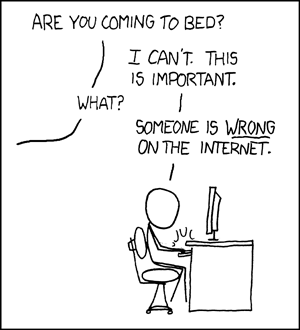
I have spent many wasted... days? weeks?—
....
Lots of my time has been wasted arguing with people on the Internet. Over a great variety of mostly inane things. The only person that I convinced of anything is me.
That's it.
Now, in reality, the people I argued with taught me something, but I was too stubborn to admit it until much later. So stubborn, in fact, and so slow to change, that I might not have even noticed my evolving opinion.
At some point during that evolution, my motives changed. It wasn't about winning anymore. People disagreed with me and I didn't understand why. I was curious. It became about learning.
This shift in perspective has been incredibly valuable. I'm slower to frustration, I waste much less time in inane arguments (though, that number is by no means zero), and I participate in much more personally interesting discussions.
I'm much less afraid of saying a wrong opinion. If I'm wrong, I'll be corrected, and all the better. People are often pleasantly surprised when I react so positively to criticism, even incredibly insulting and vacuous criticism (though, I'm not always so nice), and arguments often quickly dissolve into discussions.
Just overall pleasantness. And when I find myself in a discussion I don't care about, I just exit the conversation. When it becomes apparent I have nothing to learn or I have no interest, I attempt to graciously exit or end the argument (again, this doesn't always go as smoothly as I would like).
This transition has had its difficulties. It was quite damaging at first to concede. It was admiting defeat according to my old self, after all. It is also very tiring to work at understanding others. I spent so much of my youth building an endurance for arguing, my endurance for understanding isn't anywhere near that level.
What's great is that the system of focusing on learning has defenses against dishonesty and trolling almost built in. If someone is arguing against me in bad faith, it looks almost exactly like someone whom is impossible to understand. When this happens, I become uninterested very quickly and leave the conversation. The argument dies to nothing very quickly instead of exploding into a flame war.
This is good for various reasons. If I can't understand someone, they aren't necessarily being dishonset or trolling, but there's no talking to each other. It's probably better for everyone involved to just leave each other alone for the time being. Try again later, when maybe we've both grown enough to understand each other.
I end up getting much more out of outright arguments online, because it isn't about convincing the person I disagree with, and in fact I assume that's impossible. And even though it's still an argument, I usually end up on better terms with whomever I disagree with. I also get to learn more about myself, which really reminds me how little I know even myself.
....
This whole post kinda turned into a ramble, didn't it, Stephan? Oh, well, I hope you enjoyed reading it as much I did writing it.