
Review: A Pattern Language
10/19/14
I have finished yet another book.
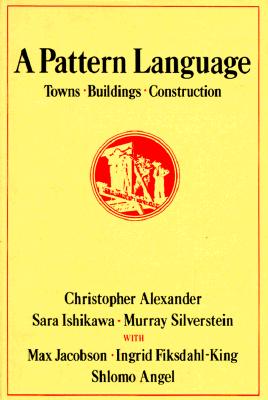
I super enjoyed reading this book. It starts at the very high level of towns and cities and works its way into individual rooms of all sorts of buildings, all of which I found really interesting, but I feel in retrospect I'm going to need to put my skeptic hat on. It ends with technical construction advice, which it says outright is not yet tested (and that they'll cover it more in-depth in the next book).
Why did I decide to read this book?
This book first popped up on my radar during my read through of The Art of Game Design, wherein author Jesse Schell described his difficulty on how to structure the world of Toontown:
Quoted from "Chapter Nineteen: Worlds Contain Spaces" under the section "Christopher Alexander is a Genuis". A Pattern Language, as well as Christopher Alexander's other texts, all got pretty high praise, and an understanding on how to craft worlds seemed incredibly valuable to me. I made a note of the book.
But high praise from one source did not push me into reading the book. A Pattern Language is a book that's inspired several other classic texts, notably (in the field of programming) Design Patterns: Elements of Reusable Object-Oriented Software.
It seemed to me that this was the kind of book that changed the way you saw the world, and that's exactly the kind of books I want to read.
The Journey Reading
I expected a book giving some basic insights into architecture and the thought process going into it.
And I got that.
But I didn't anticipate an incredibly engaging philosophy to come along with it.
A Pattern Language is comprised of 253 patterns, and a short introduction on the order and purpose of such patterns. It starts very high-level, at regions of society, and works its way meticulously to the placement of furniture. Each pattern is smaller piece of the pattern before it and composed of the patterns following it. The patterns intricately weave a fabric to serve a society.
I was going to post opinions on each pattern as I read through them, but with 253 of them within a 1200 page book, there wasn't much more than five pages per pattern. And once I started reading, I wasn't about to stop after a mere five pages. I was that engrossed.
Some particularly thought-provoking themes that I observed while reading:
Cities: Separate but Connected
Patterns of note:
- City Country Fingers
- Mosaic of Subcultures
- Scattered Work
- Identifiable Neighborhood
- Four-Story Limit
- Old People Everywhere
- University as a Marketplace
Basically, the beginning of this book feels like a pretty significant condemnation of the city as it is currently constructed. The city should be formed such that subcultures grow and are cultivated, and are not forced to conflict with each other's differences with shared space.
The individual should have human access to the governing system. Getting access to a person responsible for your part of town shouldn't be more than a friend of a friend away.
Work need not be far from home. It should be a short trip away. Ideally, such that coming home for lunch isn't out of the question.
People go crazy living too high up (there's citations for this). It separates people too much from the city, and provides too strong a motivation to isolate yourself (hypothesis of book with citations provided implying it's at least a possibility). Avoid buildings larger than 4-stories, especially buildings meant to be lived in.
The old have a lot to provide to society. Not all are equally dependant on help. A proper distribution of the old allows them to share their wisdom to anyone who is willing to hear, and also distributes professional help according to need. It need not be more expensive than nursing homes.
Everyone should partake in learning and teaching their whole life. The University should facilatate this philosophy, and be well distributed throughout the town.
More Effective Transportation
Patterns of note:
- Web of Public Transportation
- Ring Roads
- Mini-Buses
- Nine Per Cent Parking
- Parallel Roads
All forms of public transportation should be in sync with each other. Drop-off locations, timing, everything. This synergy would only convince more people to use public transportation.
Our grid road system is arachaic and inefficient. Transportation could be both faster and use less fuel even with a slight increase in travel distance.
Buses as they exist right now fall way short of what they could be. Imagine a hybrid bus-taxi system. One need only walk to the closest bus stop (and hopefully there is one every 600 feet along major roads), call in your destination using the bus stop's phone (this book was written in the '70s), and the bus station's home computer will calculate the best route change for all buses such that you reach that destination with fewest detours among all passengers (only one bus ride).
Parking shouldn't take over the land. No more than nine per cent parking in any area. No cheating by putting all the parking for one area in another one. With proper public transportation and road design, this need not be inconvenient for the population.
The Plan to Return
The book makes some big statements that I don't see being put into effect much anywhere. I am curious if their philosophy, though nice in theory, isn't actually applicable. Their transportation theories, in particular, feel easy to test via simulation, and that's something I'd like to do in the near future (deadline: end of the year).
The mini-buses idea seems particularly interesting to me. Especially if, as they believe, one could save time, money, gas, and maintenance (basically all the things) with the system.
I would also like to actually blog/tweet through each pattern in the book at some point, too. That's a long project, and not something I plan to do for a while (deadline: 2016).
The actual construction section of this text went a little over my head. Which is unfortunate, because I am a home owner, and DIY home projects seem very interesting to me. And the actual content of the section was very interesting. For example, concrete with qualities very similar to wood? Yeah, they talk about such a concrete, and how useful it can be in construction. I was unaware of such a concrete.
They also outright state that the construction section was a work in progress, and plan to release another volume in their work on construction. Perhaps I'll check that book out.
Conclusion
A really fun book to read that changes the way you look at how the systems that run the society you live in are affected by the structural foundation.
I think everyone should read this book. I think everyone should try to apply the idea of patterns to what they do or love doing. I think we should do as this book suggests and build upon the patterns they present.